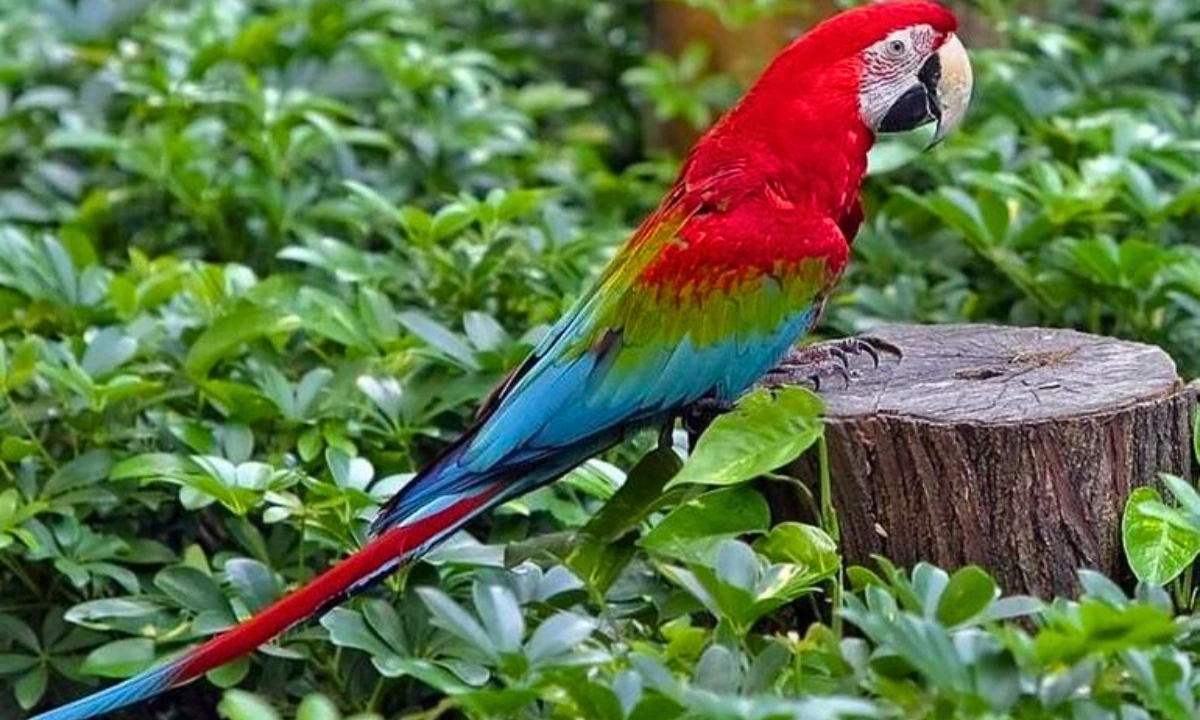
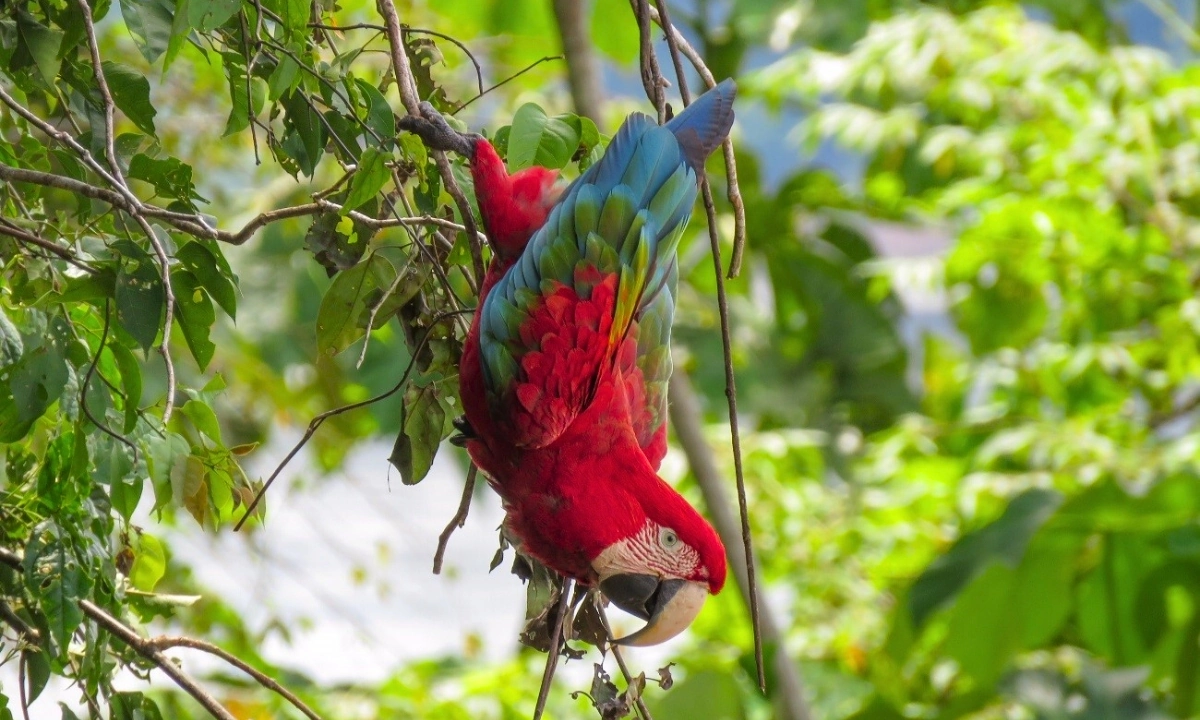
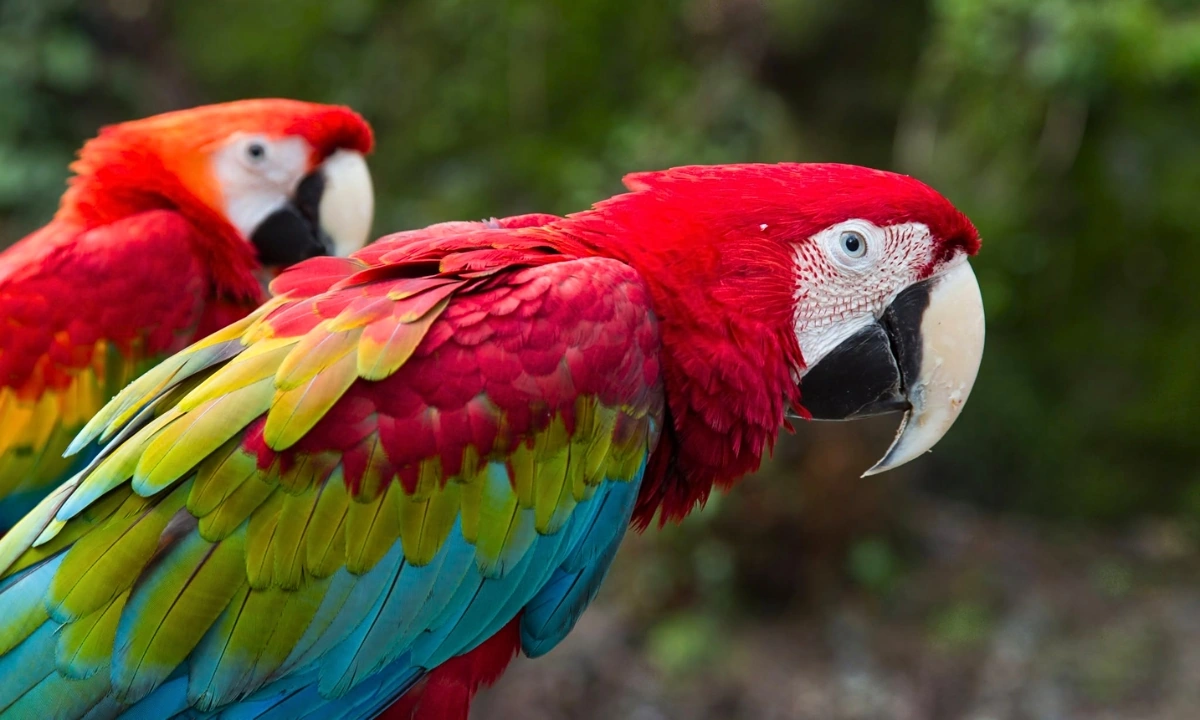
The red-and-green macaw (Ara chloropterus) is one of the largest and most striking birds in the Peruvian Amazon. Its bright red plumage and broad green band across its wings make it unmistakable. These monogamous birds form lifelong pairs and typically live up to around 30 years. In Peru, they inhabit mainly the tropical rainforest of the Madre de Dios region. There, at dawn, thousands of macaws gather at the famous clay licks, creating an unforgettable spectacle. If you want to discover where to see them in the wild.
Red-and-green Macaw in the Amazon: Tambopata
In the Peruvian Amazon, the red-and-green macaw lives in vast forest areas near rivers. The Tambopata National Reserve (Madre de Dios) is one of the best places to see them. Every morning, groups of these macaws (along with other species) fly to clay licks such as the Colorado Clay Lick, the largest in the world. At the Tambopata Research Center (TRC), a famous scientific project was established to study them, but any visitor can observe them from the trails and viewing platforms.
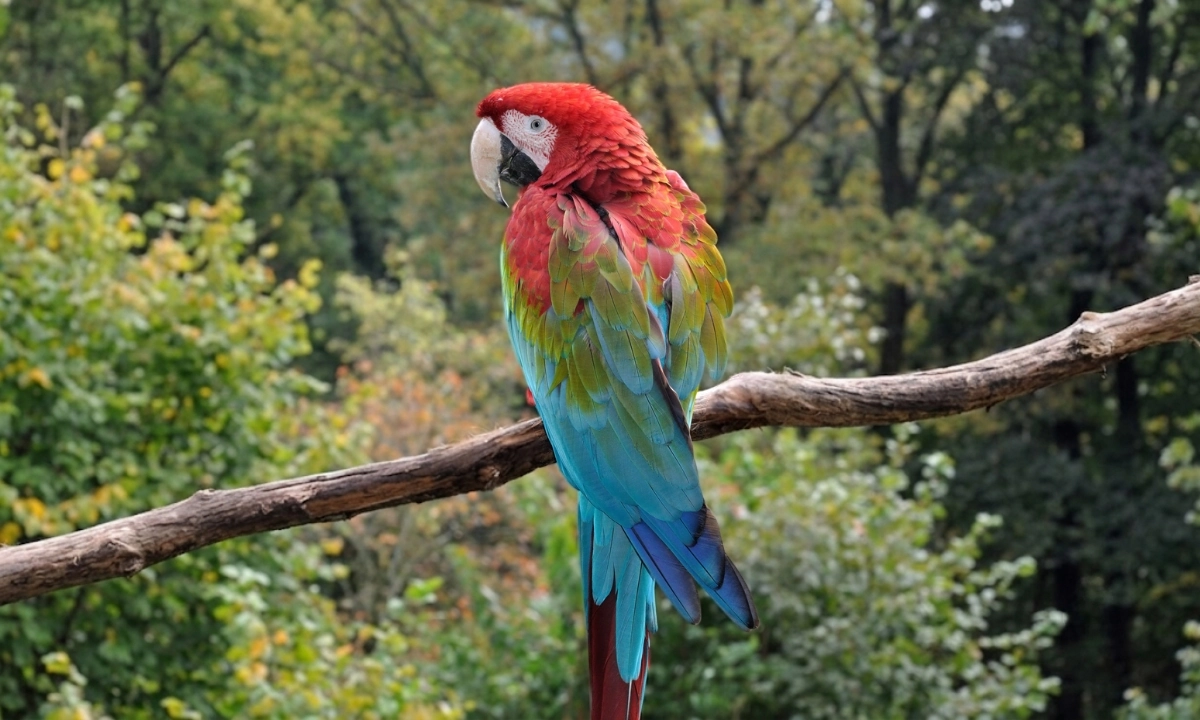
Behavior and interesting facts about the Red-and-green Macaw
- Size and weight: Measures between 90 cm and 95 cm in length (including the tail) and weighs around 1.2 kg.
- Color and sound: Its body is deep red with green highlights on the wings. It has a loud, harsh call that it emits while flying.
- Social behavior: It is diurnal and highly sociable. It is generally seen in inseparable pairs or small family groups. However, in areas rich in food (for example, clay licks), flocks of hundreds of individuals may gather.
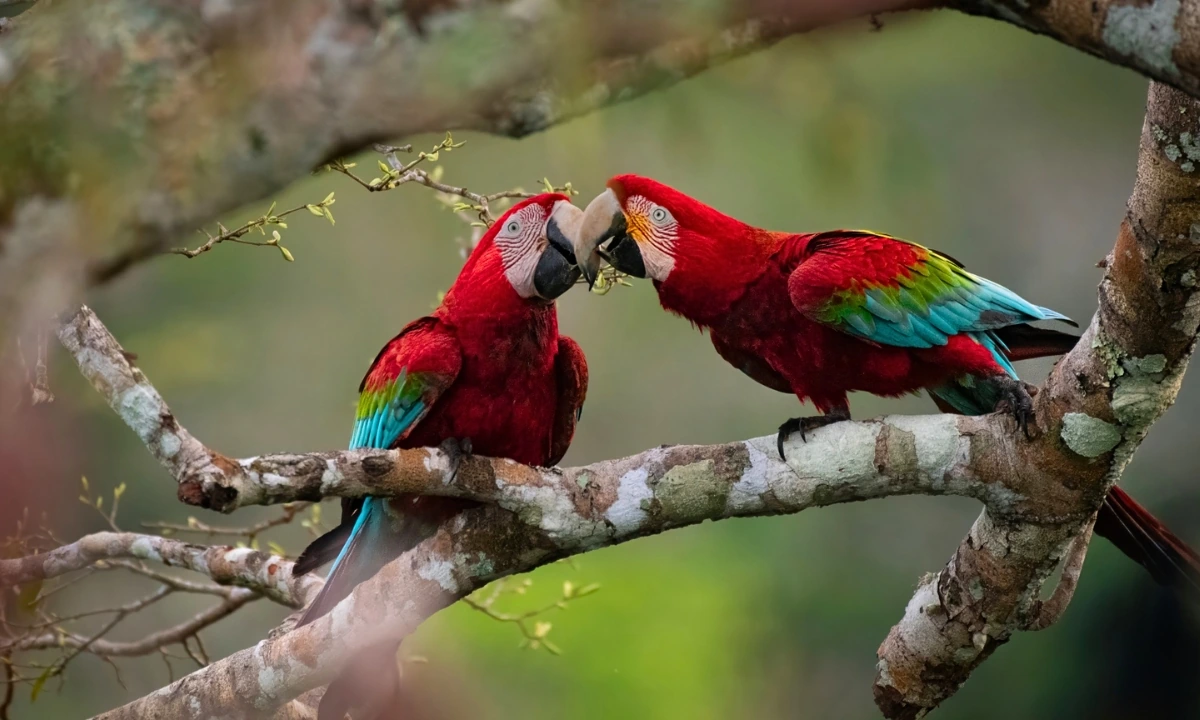
- Mate for life: It forms monogamous pairs that remain together for life. This bond is essential for raising their chicks together.
- Diet: It feeds mainly on seeds, fruits, and nuts. It occasionally visits clay licks to supplement minerals in its diet.
- Reproduction: They nest in high cavities of large trees (such as palm trees or shihuahuaco trees). The female lays between 2 and 4 eggs per clutch, which are incubated for about 27 to 30 days.
- No visible sexual dimorphism: At first glance, males and females are practically identical in size and color. The only precise way to determine their sex is through genetic (DNA) testing or endoscopy.
- Highly intelligent: Like other parrots and macaws, it possesses a great capacity for learning, memory, and problem-solving.
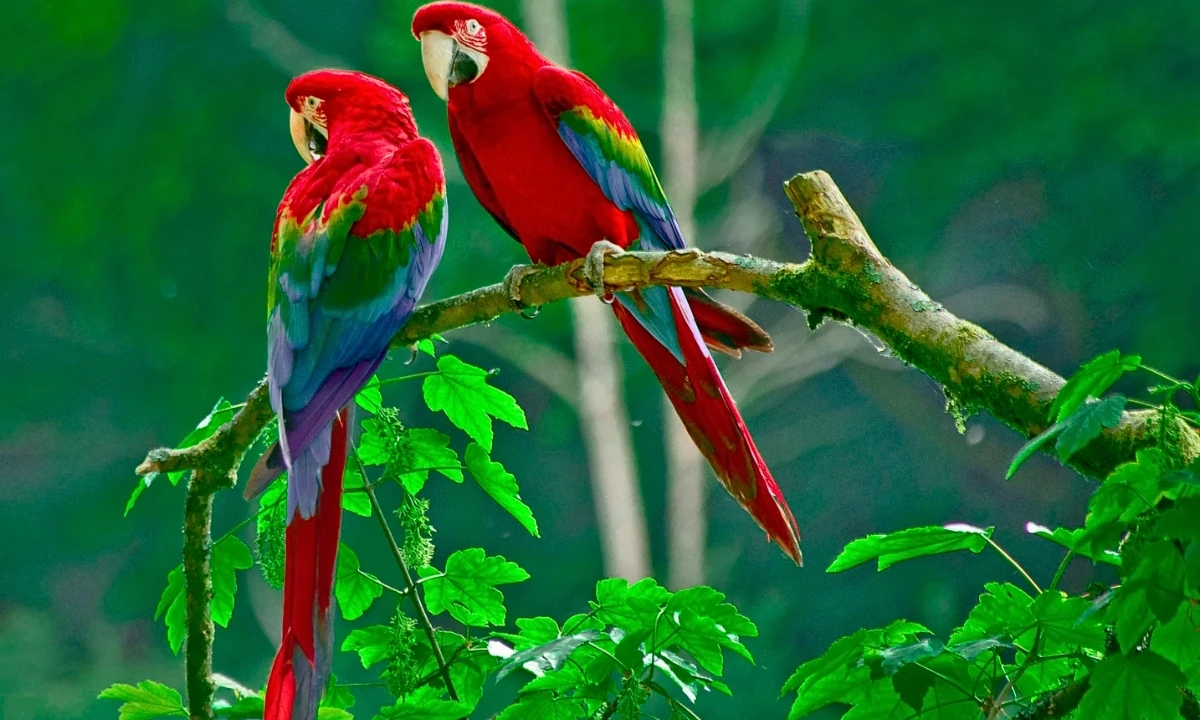
Characteristics of the Red-and-green Macaw
- Scientific name: Ara chloropterus.
- Size: 90–95 cm (from the tip of the beak to the tail).
- Weight: Approximately 1.1–1.7 kg.
- Lifespan: Lives up to about 30 years in the wild (in captivity it can exceed 50 years).
- Diet: Herbivorous; its diet includes seeds, fruits, and flowers. It also consumes mineral-rich clay at clay licks.
- Reproduction: Monogamous (lifelong pair bond). Nests in tree cavities or cliffs. They usually lay 2–4 eggs, which are incubated for about 4 weeks.
- Conservation status: The IUCN classifies it as Least Concern, although its populations are declining due to forest loss and illegal hunting.
Habitat of the Red-and-green Macaw
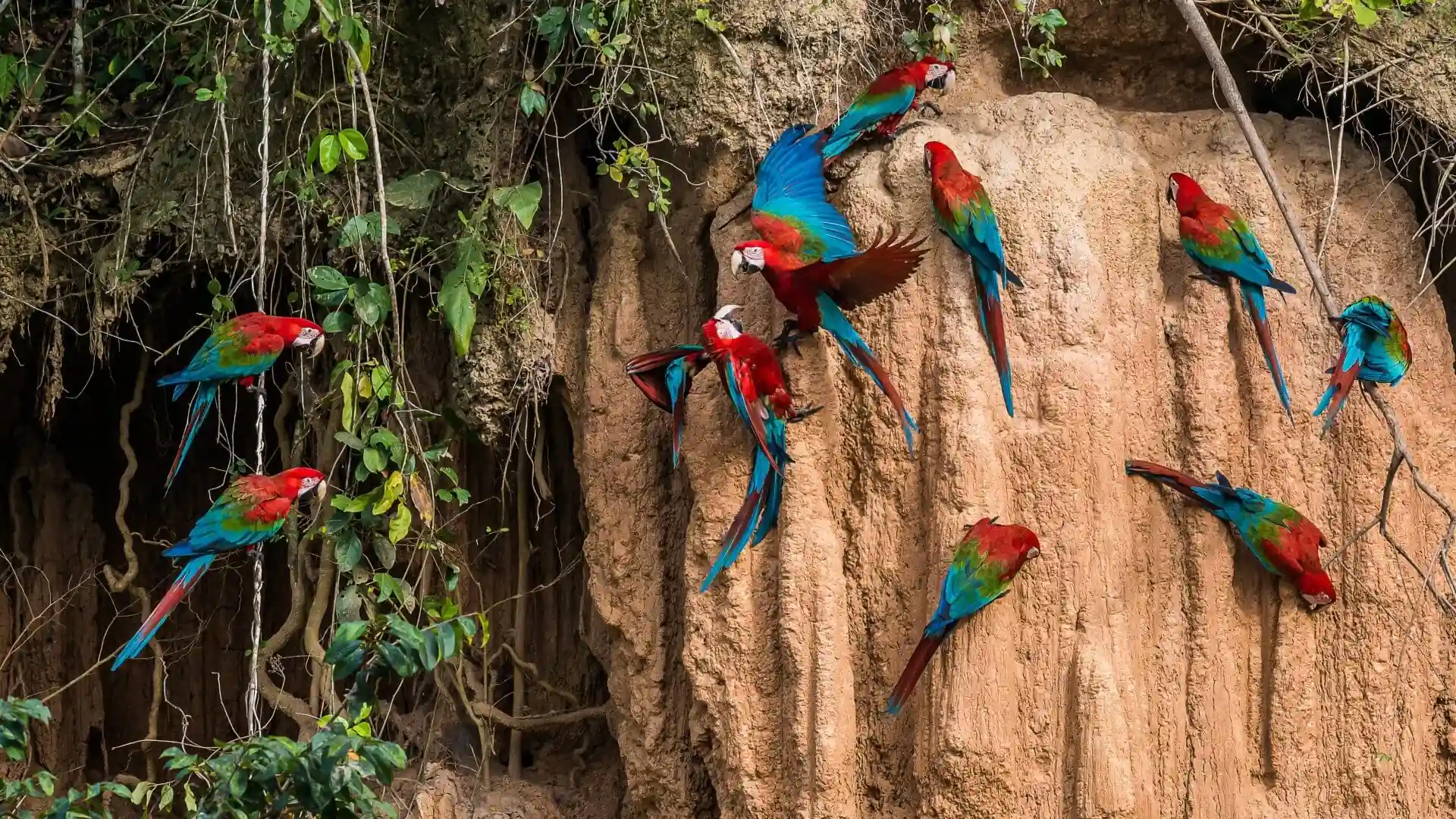
The red-and-green macaw inhabits evergreen lowland tropical rainforests, especially primary forests near large rivers. It prefers areas where giant trees (such as the shihuahuaco) still exist with cavities suitable for nesting. Within its Neotropical distribution, it can be found from eastern Panama and Venezuela to northern Argentina, but in Peru its best refuge is the eastern Amazon. For example, in Tambopata (Madre de Dios) and Manu, red-and-green macaws gather at clay licks. At the Colorado Clay Lick (Tambopata), a cliff 25–30 m high and 500 m long near the TRC lodge, up to 17 species of parrots and six species of macaws visit, including the red-and-green macaw.
Tambopata (Madre de Dios)
In the Tambopata National Reserve, located east of Puerto Maldonado, red-and-green macaws can be seen relatively easily. The conditions there are ideal: pristine rainforest, clay licks, and expert local guides. In fact, the Colorado Clay Lick, next to the Tambopata Research Center, is famous worldwide as a birdwatching site. Every morning, dozens of red-and-green macaws (along with scarlet and blue-and-yellow macaws) fly to this clay lick to eat clay. The group flights, dawn calls, and the contrast of their plumage against the green forest create a spectacular scene that fascinates visitors and photographers.
Excursions or Tours to Observe Red-and-green Macaws
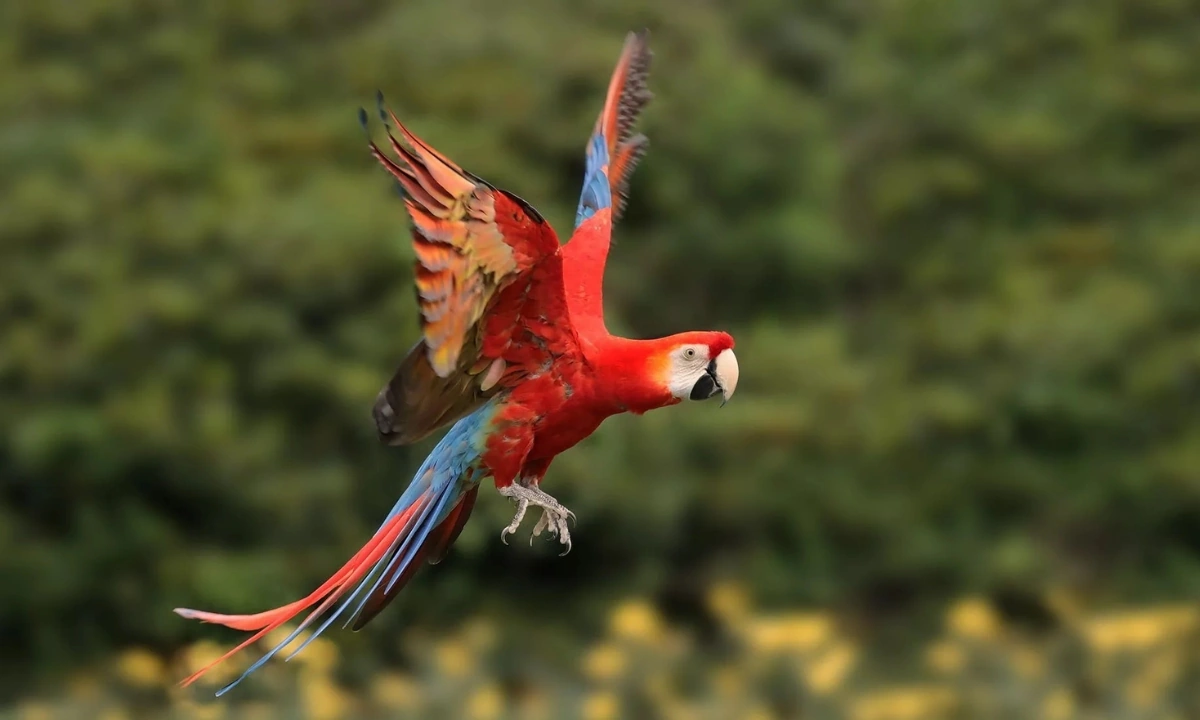
Most excursions include boat rides along the Tambopata River and early morning walks through the rainforest to the macaw clay licks (Colorado Clay Lick or Chuncho Clay Lick). For example, when visiting the Colorado Clay Lick, guides set up spotting scopes from which tourists can observe dozens of parrots and macaws emerging from the rainforest and flying toward the clay cliffs. Other tours allow visitors to climb the observation tower at the Tambopata Research Center or nearby lodges, providing a panoramic view of the forest canopy where macaws often perch. In addition to red-and-green macaws, it is common to spot scarlet and blue-and-yellow macaws, monkeys, toucans, and other Amazonian wildlife during the same excursion.
Best Time for Red-and-green Macaw Watching in the Amazon
The ideal time to see red-and-green macaws is linked to their breeding season. According to studies conducted by the Tambopata Research Center, between September and January there is the highest level of activity at the clay licks, coinciding with the reproductive period of these birds. During these months, macaws gather in greater numbers to feed and nest. In general, the dry season from November to March is also optimal because wildlife is usually more visible and hiking conditions are more comfortable. In contrast, the months of April to June are the least active at the clay licks. If you are planning a birdwatching trip, keep in mind that between September and February the chances of seeing large flocks of macaws in Tambopata are at their highest.
Frequently Asked Questions About the Red-and-green Macaw
1. How can you distinguish the red-and-green macaw from the scarlet macaw?
The red-and-green macaw has a broad green band in the middle section of its wings, while the scarlet macaw has a yellow band instead. In addition, the red-and-green macaw has a proportionally larger beak, and its face displays fine red lines on the white skin. Overall, the red-and-green macaw appears slightly more robust and has less yellow on its wings.
2. What does the red-and-green macaw eat?
Its main diet consists of seeds, fruits, and rainforest flowers. It has a very strong beak that allows it to crack hard nuts. In addition, like other Amazonian macaws, it visits clay licks to ingest mineral-rich clay. The clay is believed to provide minerals (such as sodium) or help neutralize toxins from the plants they consume.
3. How does the Red-and-green Macaw reproduce?
These birds are strictly monogamous, forming lifelong pairs. They nest in natural cavities of tall trees (for example, palms or trees of the genus Dipteryx) or even in holes in cliffs. The female usually lays 2 to 4 eggs per clutch, which both parents incubate for about 27–35 days. After hatching, the chicks are fed by both parents for several months until they learn to fly.
4. Where can you see the Red-and-green Macaw in its natural habitat in Peru?
The best place is the Tambopata National Reserve in Peru, especially the Colorado and Chuncho clay licks near Puerto Maldonado. This is where tour operators organize daily excursions to observe them. Other destinations in the Peruvian Amazon include Manu National Park and protected areas, but Tambopata is the most accessible and reliable place to find them.
Red-and-green Macaw Watching Excursion
Plan your trip with Travel Peru Agency and customize your tour to the Tambopata National Reserve, one of the best destinations for observing the red-and-green macaw in the Peruvian Amazon. Our tours include specialized guides, visits to impressive macaw clay licks, rainforest hikes, boat rides on Amazonian rivers, and the opportunity to observe a great diversity of wildlife in its natural habitat. Contact us and book your red-and-green macaw watching experience in Tambopata.